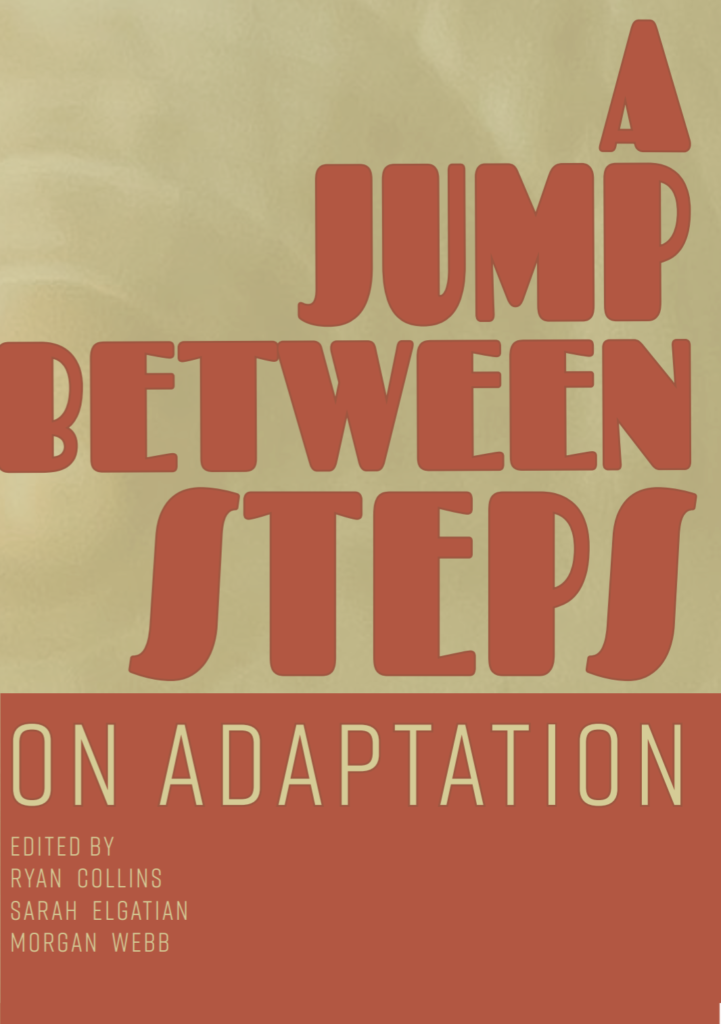
Contributors to A JUMP BETWEEN STEPS (on Adaptation) will read their work at the book release event on Thursday, April 30, 6pm, at St. Ambrose University’s Galvin Fine Arts Center. The contributors are (in alphabetical order):
Eleanor Ambler | Sophia Best | Ann Boaden | Vivian Bornhoeft | Lynn Carlsten | Melissa Conway | Claire Dodson | Daniel J. Flosi | Nancy Hayes | June Heller | Lyn Kress | Ron Lackey | Farah Marklevits | Molly McGuire | Sam Miller | Daniel E. Salazar | Anna Terry | Emily Tobin | Elena Vallejo | Morgan Webb | Tysia Webb-Bey | Esther Windt | David Wright
The first 25 people to attend the event will receive a complimentary copy of the anthology. There will be copies available for purchase during the event and via the MWC Press online bookstore after the event.
You can pre-order your copy today by clicking here
(please note: you do not need a PayPal account).
MWC collaborated with Galvin Fine Arts at St. Ambrose University to organize a series of events, activities, and publications around the theme of “Adaptation.”
In the fall of 2025, we held a submission call for poems, stories, and essays from local writers around this theme. The submissions were read blindly by MWC Press who selected 23 works for inclusion in anthology, which our publishing imprint MWC Press will publish at this event at Galvin Fine Arts Center on April 30, 2024.
This anthology is supported by the MWC Legacy Society, and the Illinois Arts Council.
Adaptation – Project Description
ABOUT THE PROJECT
St. Ambrose University College of Arts and Sciences, Galvin Fine Arts, and the Midwest Writing Center (MWC) are partnering on a series of events and a publication around the theme of “Adaptation.”
For this project, we are looking for submissions of poetry (30 lines max.) and flash prose (fiction or nonfiction, 500 words max.). Submission open September 15, and close on December 1 (see complete guidelines below). MWC will select the strongest works (approx. 20-30) for publication in an anthology, to be published by MWC Press in April 2026. All contributors to the anthology will receive $100 to their work in addition to two copies of the anthology, and the opportunity to record their work for a podcast. Selections will be announced in early January 2026.
Then, all contributors will have the opportunity to read their work during the “Speak Your Peace” event at Galvin Fine Arts on Friday, January 30, 2026 where they will have a chance to win up to $500 in a contest decided by audience members. Contributors will have the opportunity to record their works for a podcast prior to the event, and the event will be recorded live.
The anthology will be published in April 2025, and the contributors will be invited to read at a release event at Galvin Fine Arts on April 30, where the first 25 people in attendance will receive a free copy of the anthology.
PROMPT / ABOUT THE THEME “Adaptation”
(from St. Ambrose University)
Adaptation (n):
- Something that is adapted; specifically, a composition rewritten into a new form
- A process of change to become better suited to new conditions
Whether we are adapting an artistic work to a new medium (like adapting fiction into film, poetry into theatre, or a well-known children’s book into a musical) or adapting to change, whether personal, social, or environmental, adaptation is essential to [everyone] as we “become who we are meant to be.” When we reimagine artistic works and familiar texts, how do we become better storytellers and invite new perspectives on our shared human experiences?
This year of exploring adaptations and our own adaptive natures will invite us to ask ourselves: What stays the same, and what must evolve in order to remain meaningful? What beliefs or habits must we let go of in order to transform ourselves and the world around us for good?
(from Midwest Writing Center)
While a natural, and often a necessary, feature of existing in the world, it’s also important to consider when adaptation is being forced upon us, to make the truth appear false, to make wrong seem not only right but inevitable, to make the unnatural seem organic. When are we adapting out of need versus being compelled to adapt to suit the desire of others? Consider when power invokes this natural process to consolidate more power or to erase or obliterate resistance to its demands. How do we know the difference between a cover story for authoritarian pressure and healthy, positive change?
Please contact MWC with any questions about the anthology: mwc@mwcqc.org | 309 732 7330
***